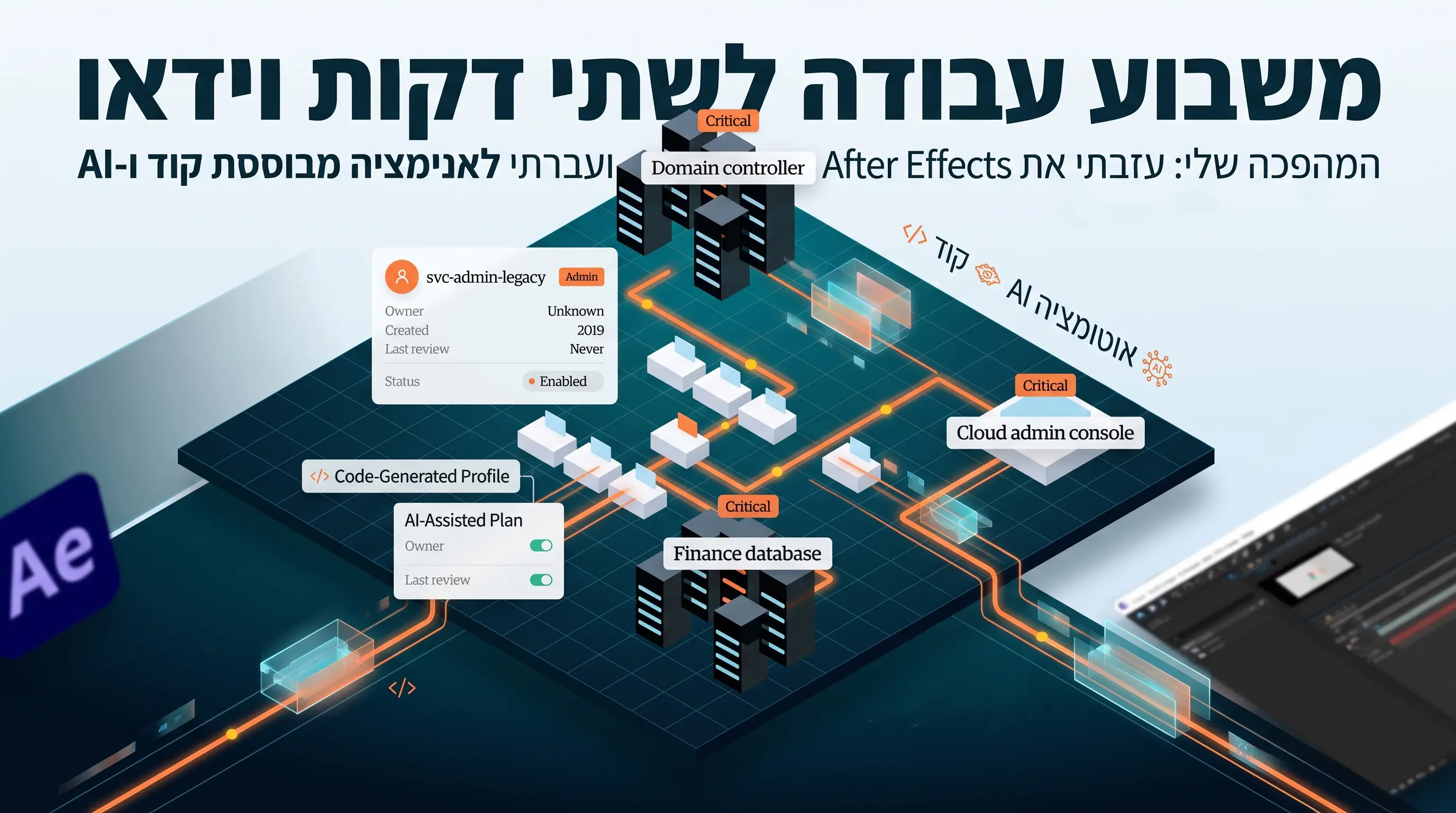
Anyone who has ever spent hours inside Adobe After Effects creating high-end motion design knows the brutal math: a solid nine-hour workday typically yields just 15 to 30 seconds of finished animation.
A concise, high-impact two-minute explainer? That meant an entire work week. Five days of nudging keyframes, adjusting curves in the Graph Editor, managing endless nested pre-comps, and getting bogged down in the mechanics of motion.
For years, I accepted this as the unavoidable cost of quality. If you want visually compelling instructional content that translates complex concepts clearly, you pay with your time.
Here is a classic example of an explainer video I produced using that traditional workflow:
The Traditional Approach: Manual motion design in After Effects - a full week of labor-intensive keyframing for just a couple of minutes of runtime.
Over the past few months, my perspective shifted fundamentally. As an instructional designer and learning technologist, my primary value does not sit in manual animation mechanics; it sits in pedagogy, narrative structure, and messaging clarity.
Today, I have closed After Effects. I transitioned entirely to code-based animation, powered by frontier LLMs.
The Shift: From Visual Timelines to Code Instructions
Instead of dragging layers along a timeline, I collaborate with advanced AI models (led by Claude Opus 5.5) to translate learning objectives, scripts, and visual concepts straight into animation code.
Here is how the workflow functions:
- Instructional & Visual Conception: I define the didactic goal, on-screen elements, and required visual flow to convey the message.
- Code Generation: The model generates production-ready code defining each motion path, timing sequence, and graphic element down to the pixel and millisecond.
- Automated Rendering: The code renders programmatically into high-definition video files - eliminating heavy render queue bottlenecks and mouse-bound keyframing.
Here is what the output looks like under this new model:
The New Approach: Code-based animation generated with Claude Opus 5.5 and rendered directly to video - produced in a fraction of the time, with complete flexibility for instant updates.
The result is smooth, highly modular, precision animation created in hours instead of days. Updating brand colors, text, or timing no longer means hunting through complicated composition hierarchies; it takes a minor prompt tweak or a single line of code.
Refocusing on What Matters: True Value in Instructional Design
The ADDIE framework has shaped instructional design for decades:
- Analysis
- Design
- Development
- Implementation
- Evaluation
The trap for many learning designers with motion skills is that the Development phase often swallows 80% of total project bandwidth. When animating a single video consumes an entire week, little room remains to evaluate learner needs, refine instructional strategies, or analyze actual learning outcomes.
Today, AI integrates across every phase of my ADDIE pipeline - from uncovering knowledge gaps to drafting pedagogical frameworks and generating final motion assets.
Compressing technical production time returns the focus where it belongs: crafting clear, impactful learning experiences. Instead of acting as an After Effects technician tweaking anchor points, I can focus fully on being an instructional architect.
Where We Go From Here
Moving to code-based, AI-driven animation is more than a workflow optimization; it is a fundamental shift in how educational content scales.
It enables organizations and independent instructional designers to produce rich, bespoke, easily maintainable video assets at the pace modern teams require. Turning an abstract idea into a polished animation in hours rather than weeks completely redefines what is possible in learning development.
After Effects served as a dependable staple for years, but the future of instructional media lies in combining solid pedagogical strategy with AI agents that handle the heavy lifting.
How is your team handling video and motion design production lately?